
Coffee roasting looks simple from far away. Beans go inside a roaster, they change colour, and then they smell amazing. But when you start learning it properly, you understand that roasting is not only about heat. It is about patience, timing, airflow, tasting, and knowing what the coffee wants to become.
Hi, I’m Aditya. I’m eight years old, and people call me the youngest roaster in India. I am still learning every day, and one thing I love the most is asking questions to coffee people who know much more than me.
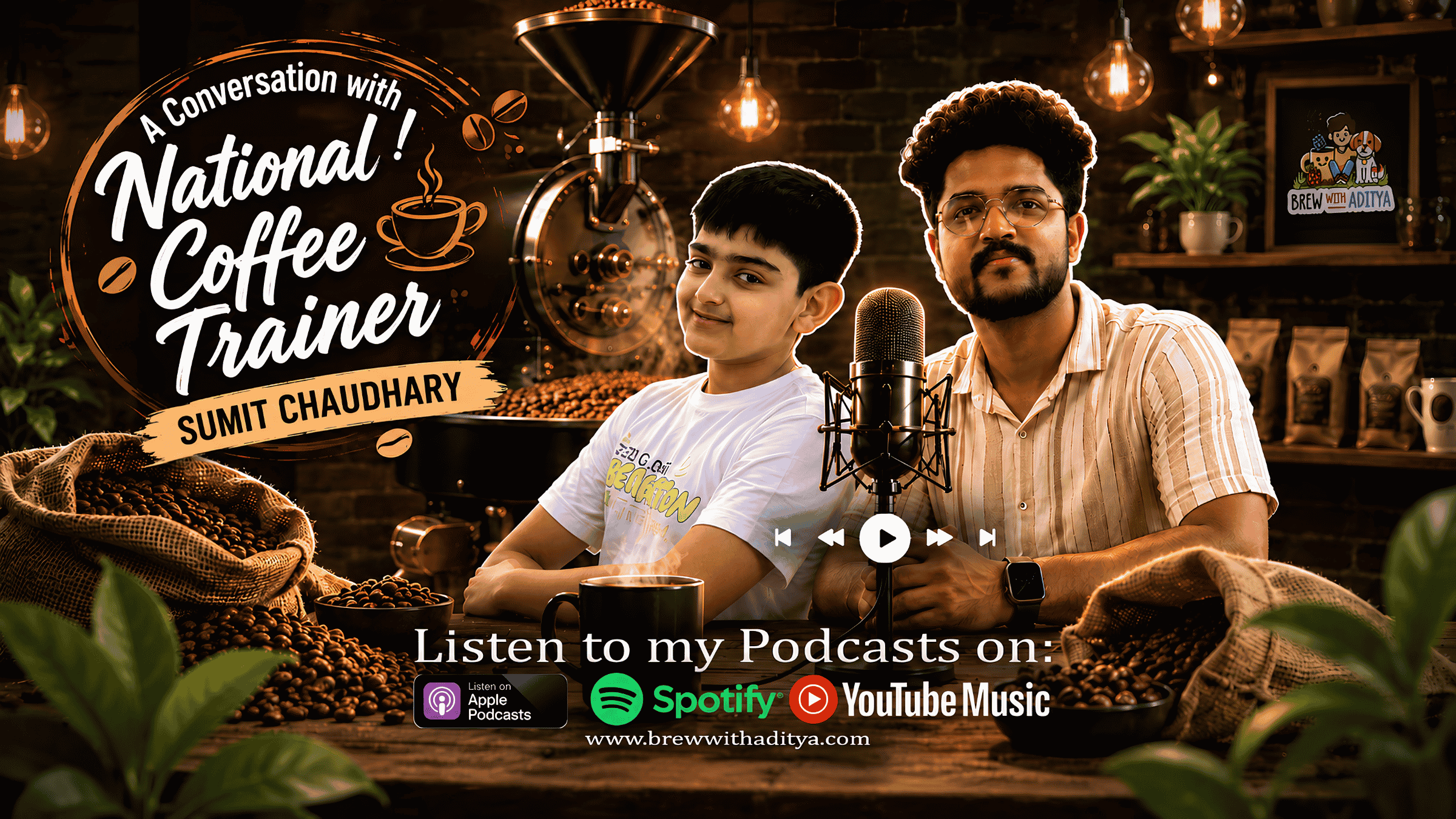
In my recent podcast, I spoke with Sumit Chaudhary, a National Coffee Trainer, barista, roasting expert, and AST SCA trainer at Kaapi Solutions. I met him during my farm-to-cup training program, and I learned many things from him. This podcast was special because I asked him simple questions that many coffee beginners also ask.
This blog shares what I learned from that conversation in simple words.
Freshly Brewed Coffee vs Instant Coffee
My first question to Sumit sir was simple: Is instant coffee bad compared to freshly brewed coffee?
His answer was very clear. He said instant coffee is not bad. It has helped millions of people enjoy coffee easily for many years. It is quick, simple, and does not need brewing tools. If someone wants convenience, instant coffee can be useful.
But he also explained that freshly brewed coffee gives a better flavour experience. When coffee is brewed fresh, you can taste more of the origin, processing method, roast profile, and natural notes. Fresh coffee can show flavours like fruits, florals, chocolate, nuts, or spices.
Instant coffee is made by brewing coffee first, then drying it into solid form. During this process, high heat can reduce aroma. That is why instant coffee often tastes simpler than freshly brewed coffee.
So, the simple answer is this:
- Instant coffee is good for convenience.
- Freshly brewed coffee is better for aroma, flavour, and sensory experience.
This helped me understand that coffee is not only about “good” or “bad.” It depends on what a person wants.
Does Dark Roast Have More Caffeine?
My second question was about something many people believe: Does dark roast have more caffeine than light roast?
Sumit sir said the answer is no, not always.
He explained that caffeine is quite stable during roasting. If you roast the same coffee as a light roast and a dark roast, the caffeine level can be very similar. Many people think dark roast has more caffeine because it tastes stronger, bolder, and more bitter.
But strong flavour does not always mean more caffeine.
Dark roast tastes stronger because the coffee has been roasted longer. The roast level changes the flavour more than it changes the caffeine. In fact, if coffee is roasted extremely dark, some caffeine can start reducing.
This was a very useful coffee lesson for me.
Simple takeaway:
Dark roast tastes stronger, but it does not automatically mean it has more caffeine. Roast level changes taste more than caffeine.
This is helpful for anyone searching things like dark roast caffeine, light roast vs dark roast, or does strong coffee mean more caffeine.
Can the Same Bean Taste Different When Roasted Differently?
This was one of my favourite questions.
I asked Sumit sir if the same coffee bean can taste completely different depending on how it is roasted. He said yes, absolutely. Even said this is one of the reasons he fell in love with roasting.
He explained roasting like cooking. The green coffee bean is like an ingredient. The roaster decides how to use heat, time, airflow, and development to bring out different flavours.
The same coffee can show different sides.
One roast may bring out:
- jasmine
- citrus
- tea-like notes
- bright flavours
Another roast from the same bean may bring out:
- caramel
- vanilla
- chocolate
- fuller body
That means two roasters can use the same bean and still create different cups. This happens because every roaster has a different style, machine setup, airflow control, heat application, and development strategy.
This lesson was very important for me as a young coffee roaster. It helped me understand that roasting is not only about copying a profile. It is about understanding the coffee and deciding what you want to highlight.
Why Two Roasters Can Make Different Coffee From the Same Bean?
This part made me think a lot.
Sumit sir said every roaster has a philosophy. That means every roaster has a way of thinking. One roaster may want to highlight fruity notes. Another roaster may want to highlight sweetness and body.
The difference can come from:
- starting temperature
- roast time
- airflow
- gas or heat adjustment
- development time
- machine style
- tasting goal
This is why coffee roasting is both science and craft. You need data, but you also need taste and experience.
Sumit sir said the bean gives the potential, but the roaster decides how that potential is expressed. I liked this line a lot because it made roasting feel like responsibility.
How Long Should Coffee Rest After Roasting?
My next question was about the best time to drink coffee after roasting.
Sumit sir explained that freshly roasted coffee is a bit like freshly baked bread. It needs time to settle.
After roasting, coffee releases a lot of carbon dioxide, also called CO₂. If you brew it too early, especially for espresso, the coffee can behave unevenly. It may have too much crema, rough flavours, muted notes, or uneven extraction.
He gave a simple guide:
- For filter coffee, 3 to 7 days after roasting can work well.
- For espresso, 7 to 14 days is usually better.
- Some high-density specialty coffees may taste even better after 2 or 3 weeks.
- In many cases, the sweet spot is between 1 and 4 weeks after roasting.
This does not mean every coffee is the same. Coffee type, roast level, storage, and brewing method all matter.
Simple takeaway:
Freshly roasted coffee is not always best on the same day. Resting helps coffee release CO₂ and brew more evenly.
This is useful for people searching coffee resting period, when to brew fresh roasted coffee, and coffee degassing explained.
Why Storage Matters After Roasting
Sumit sir also reminded us that storage matters. Even if coffee is roasted well, it can lose freshness if it is stored badly.
Coffee should be kept in:
- an airtight container
- a cool place
- a dry place
- away from sunlight
- away from heat
This helps protect aroma and flavour.
At home, this is something I also try to remember. Fresh coffee needs care even after roasting. Roasting is not the last step. Storage and brewing also matter.
The Best Roasting Advice for Beginners
My last question was about roasting tips. I asked Sumit sir what advice he would give me and other new roasters.
His answer was very important: roast with your palate, not only your software.
This means data is useful, but taste matters most. Many new roasters look only at curves, numbers, rate of rise, and software. Those things are helpful, but they cannot replace tasting.
He said every roast teaches something. That means we should keep detailed roast records.
A good roast record can include:
- temperature changes
- airflow changes
- gas adjustments
- roast time
- first crack time
- cupping notes
- what went right
- what went wrong
This is one thing I really want to practice more.
Change One Thing at a Time
Another important tip was to change only one parameter at a time.
For example, if you want to learn airflow, change airflow and see what happens in the cup. Do not change airflow, gas, batch size, and roast time all together. If you change too many things, you will not know what caused the result.
This is such a simple rule, but it is very powerful.
For new coffee roasters:
Change one thing. Taste. Take notes. Repeat.
That is how learning becomes clear.
Understand the Coffee Before Roasting
Sumit sir also said that a roaster should understand the coffee before roasting it.
Before roasting, we should know:
- Is it Arabica or Robusta?
- Is it washed, natural, honey, or another process?
- What is the density of the bean?
- Is it for manual brew or espresso?
- What kind of flavour are we trying to highlight?
This helped me understand that roasting starts before the roaster even turns on. The first step is knowing the bean.
Why Airflow Is So Important in Roasting
One thing Sumit sir highlighted strongly was airflow.
He said many beginners focus only on gas or heat. But airflow can change the cup a lot. It can affect clarity, sweetness, mouthfeel, and overall cup quality.
I understood it like this:
Airflow helps manage how heat and smoke move around the beans. If airflow is not right, the coffee can lose clarity or taste flat. If it is managed well, the cup can become cleaner and more balanced.
This is a very useful lesson for anyone learning coffee roasting basics.

My Biggest Learning From This Podcast
The biggest thing I learned from Sumit sir is that roasting is not about finding one perfect profile quickly. It is about roasting, tasting, learning, and repeating.
A great roaster is patient. Great roaster listens to the bean. A great roaster learns from mistakes.
This makes me feel happy because I am still small and still learning. I do not need to know everything today. I just need to keep learning honestly.
Coffee Words I Learned From Sumit Sir
Here are some important coffee words from the podcast:
- Roast profile: the roasting plan used for a coffee
- Development: the time after first crack that shapes the final roast
- Airflow: how air moves through the roaster
- CO₂: gas released by coffee after roasting
- Cupping: tasting coffee to judge quality
- Extraction: how water pulls flavour from coffee grounds
- Palate: your sense of taste and smell
These words sound big at first, but they become easy when someone explains them simply.
What This Means for Home Brewers
Even if you are not a roaster, this podcast can help you make better coffee at home.
Here is what you can do:
- Choose freshly roasted coffee but let it rest properly.
- Do not assume dark roast means more caffeine.
- Try freshly brewed coffee when you want more flavour detail.
- Store your beans in an airtight container.
- Change one brewing variable at a time.
- Taste your coffee as it cools, because flavours can open up.
Small steps can make home coffee much better.
My Thank You to Sumit Chaudhary
I want to say thank you to Sumit Chaudhary, National Coffee Trainer, for answering my questions and explaining everything so clearly. I liked how he made difficult coffee topics feel simple.
This podcast helped me understand roasting better. It also taught me that coffee professionals keep learning too. That makes me feel even more excited about my own coffee journey.
I will keep roasting, asking questions, taking notes, and learning one step at a time.
If you want to follow more simple coffee lessons, podcast stories, and my learning journey as the youngest roaster in India, you can visit Brew With Aditya and join me for the next coffee conversation.